 Author: Laura Bulmer
As governments across Europe continue their digital transformation programmes, e-invoicing is rapidly becoming mandatory for businesses trading domestically and internationally. While many organisations already exchange invoices electronically, the new regulations go much further than simply emailing a PDF.
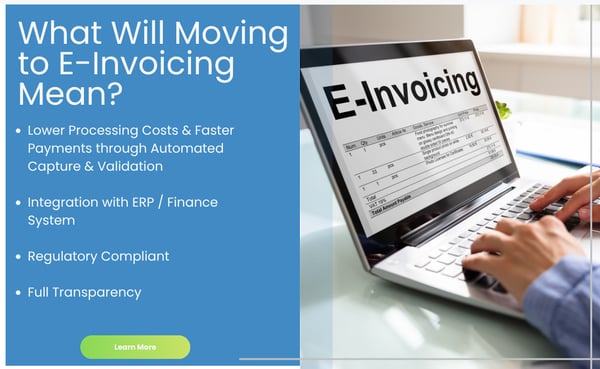 Mandatory e-invoicing introduces structured digital invoice formats that can be validated automatically, submitted directly to tax authorities in some countries and integrated seamlessly into finance systems.
For UK businesses trading with customers or suppliers in Europe, understanding these requirements is becoming increasingly important. Failure to comply could result in delayed payments, rejected invoices and regulatory penalties.
E-invoicing forms part of wider accounts payable automation projects we cover for our clients.
This guide explains:
An electronic invoice (e-invoice) is a structured digital document that can be processed automatically by accounting software and government platforms.
Unlike a PDF invoice, an e-invoice contains data in a standardised format such as:
Because the information is machine-readable, there's no need for manual data entry. Invoice details are validated automatically before reaching the recipient, reducing errors and speeding up processing.
A PDF attached to an email is not considered an e-invoice under European legislation.

 The move towards mandatory e-invoicing is being driven by several objectives.
The European VAT gap continues to cost governments billions each year. Digital invoice reporting gives tax authorities greater visibility of commercial transactions.
Manual invoice processing is slow, expensive and prone to human error. Automated invoice exchange significantly reduces administration.
Electronic invoicing creates the foundation for wider automation, including:
Many European countries are adopting common standards such as Peppol, making it easier for organisations in different countries to exchange invoices electronically.
The rollout is happening at different speeds across Europe. Some countries already require mandatory e-invoicing, while others are introducing phased implementation over the next few years.
| Country | Current Position |
|---|---|
| Italy | Mandatory B2B e-invoicing already in force |
| France | Phased rollout begins from September 2026 |
| Germany | Receiving structured e-invoices mandatory from January 2025, wider rollout continues to 2028 |
| Belgium | Mandatory B2B e-invoicing from January 2026 |
| Poland | National KSeF platform expected to become mandatory from February 2026 |
| Spain | Mandatory rollout expected following final regulations |
| Romania | Mandatory B2B e-invoicing already introduced |
| Hungary | Real-time invoice reporting already mandatory |
| Portugal | Mandatory electronic invoicing for public sector with wider digital requirements continuing |
| Greece | Digital reporting requirements continue through the myDATA platform |
| Croatia | Preparing future mandatory adoption |
| Slovenia | Planned implementation under development |
| Slovakia | National rollout planned |
| Czech Republic | Considering future implementation |
Please note: Implementation dates continue to evolve as governments publish updated legislation. Businesses should regularly monitor local tax authority guidance.
In practice, yes.
The EU's VAT in the Digital Age (ViDA) initiative is encouraging every Member State to introduce digital reporting and electronic invoicing. While each country is responsible for its own implementation timetable, the overall direction is clear.
Over the next few years, structured electronic invoicing is expected to become standard practice throughout Europe.
Businesses that prepare early will avoid last-minute disruption while benefiting from improved efficiency long before compliance deadlines arrive.
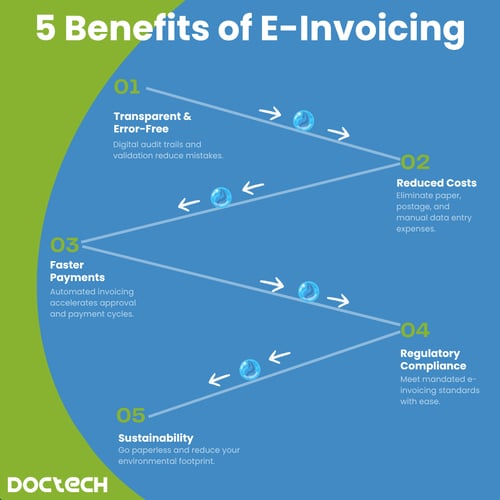
Beyond compliance, e-invoicing delivers measurable operational improvements.
Structured invoice validation reduces duplicate invoices, incorrect VAT calculations and manual keying errors.
Digital audit trails also make it easier to trace every stage of the invoice lifecycle.
Removing paper, printing, postage and manual data entry can reduce invoice processing costs significantly.
Finance teams spend less time correcting errors and more time on value-added work.
Invoices reach customers immediately.
Automated validation and approval workflows reduce delays, helping businesses improve cash flow.
Modern e-invoicing platforms automatically generate invoices in the correct format for each country, helping organisations remain compliant as regulations change.
Reducing paper usage supports environmental objectives while creating fully digital finance processes.
Many organisations include e-invoicing as part of wider ESG and sustainability initiatives.

Successful e-invoicing is about much more than creating compliant invoice formats.
Businesses also need to automate the entire invoice lifecycle, from receipt and approval through to secure storage, retrieval and audit.
Working alongside DocuWare, DocTech helps organisations:
Rather than replacing your finance software, DocuWare enhances it by removing manual administration and connecting documents with your existing business processes.
No. A PDF is simply a digital image of an invoice. A compliant e-invoice contains structured, machine-readable data that accounting software can process automatically.
Not currently. However, HMRC has been consulting on wider adoption of e-invoicing, and many UK businesses trading with Europe already need to comply with overseas requirements.
That depends on the legislation in the country where they trade. Several European countries apply mandatory requirements regardless of business size.
Peppol is an international framework that enables organisations to exchange structured electronic documents securely using a common standard. It is becoming one of the most widely adopted e-invoicing networks across Europe.
Mandatory e-invoicing is no longer a future consideration. In fact, it is already reshaping how businesses trade across Europe.
Organisations that invest now will not only stay compliant with changing regulations but also benefit from faster processing, lower operating costs and greater visibility across their finance processes.
Whether you're preparing for new legislation or looking to modernise your accounts payable function, DocTech can help you implement a secure, scalable e-invoicing solution that integrates with your existing finance systems and supports future growth. E-invoicing forms part of wider accounts payable automation projects we cover for our clients. We are happy to discuss your project irrespective of where your business is up to on this journey.
Read our previous blog at DocuWare's annual conference in Germany where our marketing manager Laura Bulmer sat down and reflected on our current position as we celebrate 30 years of providing DocuWare.


 info@doctech.co.uk
 0161 647 7040