 Author: Ruban Rajasooriyar
Manufacturers rely on ERP systems to manage everything from purchasing and stock to finance and operations. But what about the documents and processes that sit outside these systems?
Supplier invoices, material certificates, contracts, approval requests and quality records still need to be captured, processed, approved and stored.
And even with an established ERP system, many businesses continue to rely on manual data entry, emails and disconnected document processes.
That's where integrated document management and workflow automation can make a real difference.
At tk accelis Supply Chain Solutions UK (tk accelis), DocuWare has supported document management and business processes for more than 20 years, integrating with existing systems and evolving alongside the organisation.
Here's how DocTech has helped this materials manufacturer improve its document processes, and what other manufacturing businesses can learn from its experience.

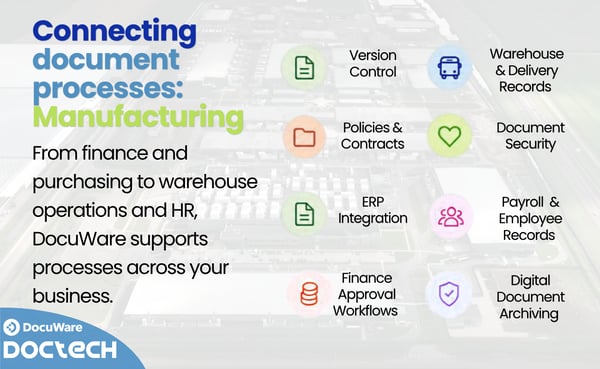 Manufacturing and materials businesses handle large volumes of information across departments, sites and business systems.
Even with a sophisticated ERP system, managing the documents behind everyday transactions can create unnecessary administration.
Common challenges include:
An ERP system may manage the transaction, but what manages the documents and workflows surrounding it?
By integrating document management software with existing business applications, manufacturers can reduce manual processes, improve access to information and maintain greater control over their documents.
tk accelis Supply Chain Solutions UK is a materials and manufacturing business managing significant volumes of documentation across its operations.
DocTech first implemented DocuWare on-premise in 2005, providing a central system for digitally storing and managing business documents.
Over the following 20 years, the system evolved to support additional processes, including document workflows, digital approvals and integration with the company's existing ERP environment.
Rather than operating as a standalone document repository, DocuWare became part of the organisation's wider business processes.
This approach helps businesses manage documents alongside the information held in their ERP systems, reducing reliance on disconnected manual processes.
For manufacturers, the real value comes from connecting documents, data and workflows with the systems already supporting their operations.
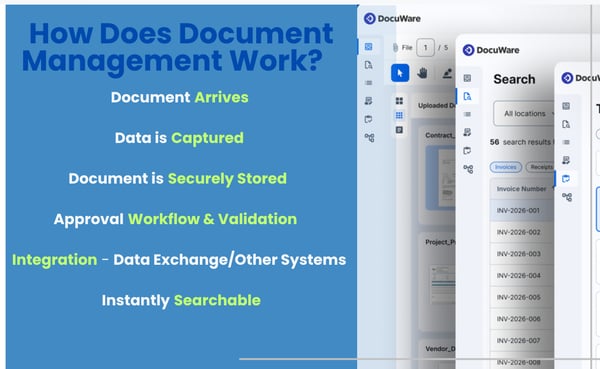 ERP systems are essential to manufacturing operations, but they don't always provide the flexibility needed to manage every document or approval process.
For example, a supplier invoice may need to be captured, checked, approved and archived, while the corresponding financial transaction is managed within the ERP.
Similarly, quality documentation and material certificates may need to be linked to relevant records, accessed by different departments and retained for future reference.
DocuWare complements existing ERP software by providing document management, data capture and automated workflows.
Depending on the integration and processes involved, manufacturers can benefit from:
The objective isn't to replace an ERP system. It's to make the processes surrounding it more efficient.
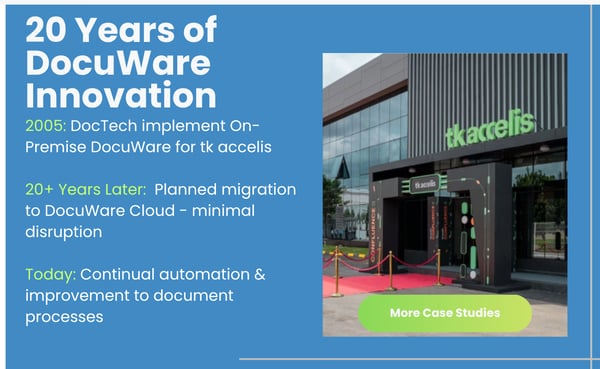 After two decades using DocuWare on-premise, tk accelis migrated to DocuWare Cloud in late 2025.
For an established manufacturing business, migrating a document management system that supports everyday operations requires careful planning.
DocTech managed the migration, carrying out work outside normal business hours to minimise disruption.
The move to Cloud has provided a modern platform for the company's ongoing document management requirements, reducing the need for local system maintenance and creating opportunities for further automation.
With an in-house specialist continuing to develop the system, tk accelis is now looking at additional ways to improve processes and make greater use of DocuWare's capabilities.
It's a good example of how established manufacturers can modernise their document management without starting from scratch.
For manufacturers, one of the most promising developments in document automation is AI-powered Intelligent Document Processing (IDP).
Businesses in the materials sector regularly handle technical documents containing complex information, including material test certificates.
These documents can be time-consuming to review and process, particularly when information arrives in different formats.
tk accelis is exploring how DocuWare IDP could help identify and extract relevant information from material test certificates.
This technology can automatically classify documents and extract data, reducing the need for employees to manually review and enter information.
For manufacturers handling high volumes of technical documentation, AI document processing offers further opportunities to improve accuracy, reduce administration and make better use of the information they receive.
The tk accelis story demonstrates that document management isn't simply about replacing paper with digital files.
It's about building connected processes that support the way a business operates.
From its original on-premise implementation in 2005 to ERP integration, workflow automation and its recent Cloud migration, DocuWare has continued to evolve with the organisation.
And manufacturers don't have to automate everything at once.
Whether the priority is supplier invoice processing, quality documentation, purchase approvals or integration with existing software, improvements can be introduced gradually.
The starting point is identifying which document processes are still manual, disconnected or unnecessarily time-consuming.
DocTech works with manufacturers, materials suppliers and engineering businesses to implement document management, workflow automation and integrations with existing ERP and finance systems.
With experience supporting hundreds of organisations, we can help identify where DocuWare could improve your existing processes.
Contact DocTech to discuss your manufacturing document management and ERP integration requirements.


 info@doctech.co.uk
 0161 647 7040
