 Author: Nicky Metcalfe-Dennis
For many years, Document Management Systems (DMS) were primarily associated with digitising paper and automating structured, repeatable processes such as Accounts Payable (AP) invoice processing. While this remains an important use case, it is no longer enough to support the way modern organisations operate. Processing documents which contain Unstructured data is on the radar for most businesses and if it's not yet, it soon will be.
Today’s businesses are dealing with a far broader and more complex challenge: unstructured data.
Emails, scanned correspondence, contracts, HR records, complaints, quality documentation, and incoming customer communication all arrive in multiple formats, from multiple channels, and often without a consistent structure. As a result, traditional template-driven document capture and static workflows are struggling to keep pace with operational demand.
Historically, document management relied heavily on predefined templates. If a document looked a certain way, such as an invoice could be indexed, validated, and routed through a predictable workflow.
However, modern business processes rarely follow this structure.
Information now enters organisations through:
This creates a constant flow of unstructured and semi-structured content that cannot always be captured through rigid templates alone.
Traditional document capture methods depend on fixed rules and predictable layouts. While effective in controlled environments, they are limited when faced with variation, exceptions, and human-driven communication.
For example:
This variability introduces delays, manual intervention, and inconsistent processing outcomes.

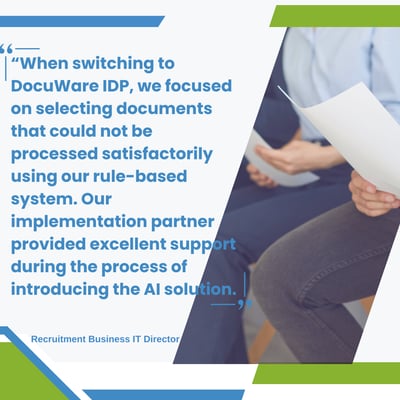
.png?width=400&height=400&name=IDP%20Recruitment%20%20(1).png) Modern platforms such as DocuWare are enabling a shift toward Intelligent Document Processing (IDP), where documents are no longer just stored and indexed, but understood.
Modern platforms such as DocuWare are enabling a shift toward Intelligent Document Processing (IDP), where documents are no longer just stored and indexed, but understood.
Instead of relying purely on templates, DocuWare IDP can classify document types automatically, extract relevant information, and route content into appropriate workflows, regardless of format or source.
This enables organisations to move beyond AP automation into broader use cases such as:
The result is a more connected and responsive organisation, where information flows intelligently across departments.
 The evolution of document management is no longer about where documents are stored, but how information is used.
Modern platforms such as DocuWare now enable organisations to connect data across systems, automate decision-making, and manage end-to-end processes rather than isolated tasks.
This shift is critical because the majority of business-critical information is no longer structured. It is contextual, variable, and often arrives in real time from multiple sources.
When reviewing your current document management approach, there are several key questions to consider:
Many organisations begin with finance automation but quickly identify additional high-value use cases across HR, operations, and compliance.
If a large proportion of documents arrive via email, free text, or mixed formats, template-based capture alone may not be sufficient.
In many cases, a phased approach using cloud capabilities alongside existing systems can reduce risk and improve adoption.
Features such as workflow automation, digital forms, and e-signatures often deliver quick wins when introduced alongside existing systems.
As document volumes increase, scalability becomes a key factor in long-term system performance.
Modern DMS strategies often succeed when business units can adopt automation incrementally rather than waiting for enterprise-wide change.
Document management is no longer just about storing documents or automating invoices. It is becoming a core enabler of digital transformation across the entire organisation.
As businesses face increasing volumes of unstructured information, the ability to intelligently capture, classify, and route data is essential.
Whether through cloud adoption, hybrid approaches, or the evolution of existing on-premise systems, the goal remains the same: turning information into actionable insight.
Organisations that embrace this shift will be better positioned to improve efficiency, strengthen compliance, and deliver more responsive services across every department.
DocTech are based in Manchester, UK and have provided Document Management Solutions for over 40 years. They are known for implementing and supporting some of the most sophisticated document management systems in existence. They have been DocuWare specialists for 30 years and can integrate DocuWare seamlessly with your other solutions such as Finance software, ERP and almost any 3rd party application. If you'd like more information or a demo about the solutions we provide to tackle data capture of all kinds, please get in touch. 

 info@doctech.co.uk
 0161 647 7040